

Ultra-fast, Ultra-efficient
redefining wireline communication & lightweight coherent optics
Our current research domains
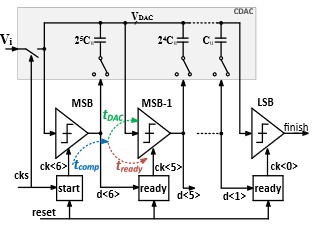
Analog Converters
In our lab, we push the limits of data conversion technology — designing cutting-edge architectures for analog-to-digital (ADC) and digital-to-analog (DAC) converters. From inventing advanced architectures for data converters to crafting precision analog and mixed-signal circuits, we blend creativity with engineering rigor. You’ll work with industry-grade design tools, tackle real-world challenges, and help shape the future of high-speed, low-power communication systems.
Picture from A loop unrolled fully asynchronous SAR ADC and FFT spectrum (C. Bheemisetti, et al., JSCC, 2024)
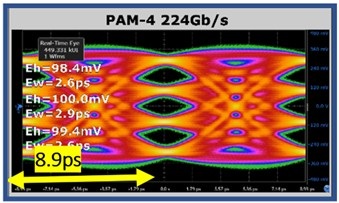
High-Speed Wireline Transceivers
In our lab, we push the limits of high-speed wireline communication — designing transceivers that deliver unprecedented data rates with exceptional power efficiency. Building on our experience developing 200 Gb/s transceivers, we now tackle the next frontier: overcoming the data bottlenecks of modern data centers, machine learning, and AI computing. Our research explores bold directions — from doubling lane rates beyond 200 Gb/s toward terabit-class ports, to rethinking transceiver architectures that rely more on analog filtering and equalization and less on power-hungry digital signal processing. You’ll work with industry-grade design tools, take a system-level view, and help shape the future of ultra-fast, energy-efficient communication systems.
Picture from M. Cusmai et al., ISSCC 2024
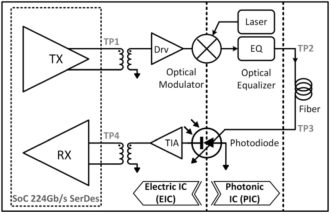
Power-Efficient Optical Transceivers
In our lab, we explore the frontier of power-efficient optical transceivers — where electronics and photonics converge to enable the next generation of ultra-fast communication networks. As data rates continue to climb, overcoming impairments in both electrical and optical domains becomes critical. Light offers unique advantages, including enormous bandwidth and far lower attenuation compared to purely electrical links — making it the medium of choice for scaling future systems. Our research focuses on co-design: inventing joint electrical–optical filtering and equalization techniques that optimize overall system performance. From high-linearity optical modulator drivers with integrated analog and optical filters, to advanced photodiode transimpedance amplifiers with analog equalization, and toward lightweight, low-power coherent optics, we tackle the toughest challenges at the intersection of circuits and light. You’ll gain hands-on experience with cutting-edge tools and help shape the future of energy-efficient, high-speed optical communication.
Picture from Direct drive linear optics SerDes (A. Khairi et al., OJSSC, 2024)
AI and DSP for Transceivers
In our lab, we explore how artificial intelligence (AI) and advanced digital signal processing (DSP) can revolutionize high-speed electronic transceivers. As systems push the limits of bandwidth, signal integrity, and power efficiency, new approaches are needed to adapt and optimize performance in real time. AI and machine learning models, such as neural networks, can outperform traditional equalizers when dealing with complex channels or nonlinear transceiver behavior. Reinforcement learning agents can dynamically tune critical parameters — gain, equalization coefficients, thresholds — to achieve optimal bit-error rate (BER) and power consumption. By combining algorithmic intelligence with circuit innovation, we aim to create the next generation of adaptive, power-efficient transceivers. You’ll work hands-on with AI-driven design tools, explore the fusion of hardware and machine learning, and help shape the future of intelligent communication systems.
Picture made with AI.
Have an idea for collaboration?
With over 25 years of experience leading advanced research and development, Prof. Cohen welcomes collaborations with both academia and industry to drive innovation in high-speed, power-efficient communication technologies.